When did photography go soft?
Soon.

Prologue
Originally, I intended to build this article as a survey of pictorialism; once and for all to attempt to locate its birth, to split apart the already disheveled history of photography and then glue it back together more neatly. But it was starting to resemble an Excel spreadsheet and a dry historiographical dissertation far too much. So I'll take a different route and begin with a paradox: how the pursuit of technical refinement created an aesthetic of imperfection. In my previous article I dealt more with general description and the practical side of things; here I would rather, instead of a broad introduction and skating over the surface, develop the damn why and the hell how. Stretch your menisci, get the vaseline ready, crack open a cold one and let's get to it.
One might not immediately think that lenses suitable for photography existed long before the invention of photography itself. Optics and lenses had been drawing images for centuries and millennia before that, and this principle was used across fields and disciplines. If I leave aside astronomy (telescopes), naval navigation (spyglasses, sextants), science (microscopes, magnifiers), and the military (sights, periscopes), and focus on art and entertainment, we would find them in plenty of places:
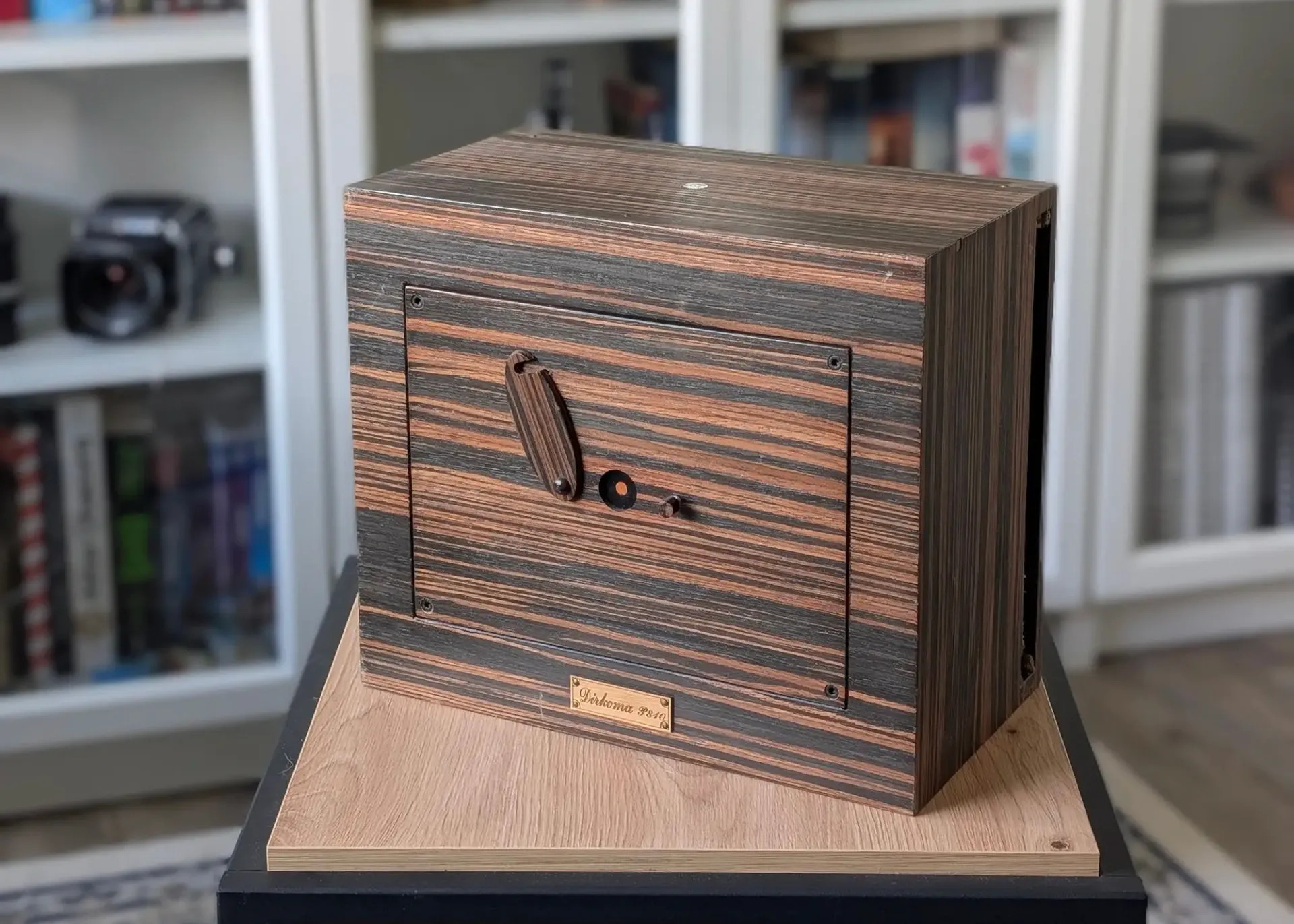
- Camera obscura—a dark chamber. It consists of a hole in a wall or in a box and that's it. Light passes through a small opening inside and an inverted image of the outside world appears on the opposite wall. No magic, no electricity, just a bit of darkness. The principle has been known for millennia; later simple lenses were added and eventually photographic material. It is the foundation of all photography, and modern cameras are just slightly more sophisticated boxes. Anyone can make a pinhole camera from anything, from a matchbox to an entire room. Or cut one out of a magazine. Or buy a nice wooden one made by Czech hands.
- Camera lucida—a "light chamber," a gadget for draftsmen. A glass prism or mirror projected the subject in front of the artist's eyes, and he could see both the model and his drawing at the same time. The subject was easier to trace, and he could pretend to be an artistic genius. Then all that remained was to enjoy countless exposed ankles and bulging corsets of enchanted ladies. The device was constructed by the Renaissance-minded William Hyde Wollaston. He also created the first landscape lens, Wollaston—in 1804, more than twenty years before photography. You can still buy a reproduction today.
- Laterna magica, or magic lantern, or skioptikon, or the great-grandfather of the projector. Inside was a candle, in front lens and a transparent image. The image was enlarged and projected onto a wall, and in the 17th century people would go hysterical over it. For greater effect, smoke was sometimes used during projection—at that point the entertainer was also playing with the Inquisition. A similar shock was probably only experienced later when a silent train by the Lumière brothers came rushing at them.
That great, enormous leap, then, was not in the invention of the lens or the camera; it lay in the fact that someone finally appeared who didn't let the image disappear.
.jpg)



I. Limits of the time
Until recently, the first surviving original photograph in history was considered to be View from the Window at Le Gras by Nicéphore Niépce from 1826–1827. Recently it was beaten by a year by Boy with a Horse (1825), and then there is also Still life of a set table (1823–1825). But there's a bit of boeuf bourguignon in that.
- The Still life of a set table would be considered the first known photograph (heliograph), if the original hadn't somehow gone missing. The current form is a 19th-century reproduction.
- The horseboy image is again an imprint of an older engraving. It is the first image created by photochemical means, but it is not a capture of reality nor an image from a camera. The first Xerox. Proof that light itself can draw an image.
- The roofs of Le Gras are thus, in the judgment of my highly esteemed authority on world photography, the first true surviving photograph. The image was created by an eight-hour exposure on a pewter plate coated with an asphalt mixture. Today you commonly have 1/8000s on your camera. That's more than 230 million times faster. And without asphalt.
As you can see, the first photographs looked similar to the first digital photographs. Man is driven by the desire for improvement, so it stands to reason that the dawn of the photographic craft was generally devoted to achieving perfection—this fit into the emerging era of realism and the effort for a faithful imprint of the world, for accuracy and objectivity. The stumbling block was the insufficient maturity of the technology of the time. The first achromatic designs were very simple little lenses suffering from all possible optical errors. Lens speed was more like lens slowness (at best ~f15) and sharpness wasn't exactly present either. Pictorialism was still far away, but already now photography was somehow blurrier—not intentionally and beautifully, but accidentally and ugly. Realism was still more in the heart and mind, certainly not in the result. Photography softened as soon as it was born.
The heads of physicists therefore tried to crack the three most uncrackable nuts of the newly born photography: lens aperture, sharpness, and the largest and flattest possible coverage—and how to combine and improve all of it. It didn't take long before the work succeeded.
II. Triumph of perfection
There's probably no need to introduce Joseph Petzval—he created in 1840 the first mathematically calculated lens in the world, the Petzval. It was a revolution in optics, sharpness and speed, which at f3.6 was something unseen until then. However, somewhat unjustly, an earlier giant is a bit forgotten, who just before Petzval significantly advanced usability and photography as a field—Charles Louis Chevalier.
Charles Chevalier was playing with glass even before photography was discovered, and titans such as Niépce, Daguerre, Talbot, or Bayard worked with his lenses. Like others, he started simply and reached more complex designs with better optical properties in the same year as Petzval. For the French academic society SEIN he presented his magnum opus, the double achromatic Verres Combines. It allowed changing focal lengths by swapping parts of the lens, and the speed improved by several orders of magnitude to f5. Its versatility and elegance impressed the jury so much that Chevalier dominated the competition and won the contest with a Médaille d'Or.
- Verres Combines was one of the first truly practical photographic lenses. Compared to his colleague, it was less sharp but more uniform across the field and more refined in rendering. Thanks to modularity, it could serve as both a landscape and portrait lens—basically the first zoom.
- The Médaille d'Or was the highest industrial award granted by French scientific and industrial commissions, which often rewarded unconventional approaches and progress.
- In early evaluations by the Société d'Encouragement, Chevalier's optics were often considered technically superior to Petzval's design; however, the latter, thanks to extreme speed and better sharpness (albeit mostly away from the edges), ultimately dominated practice and the market. Chevalier won the medal, Petzval won history.
,_Ni%C3%A9pce_1827_%E2%80%94_HRC_2020_(cropped).jpg)


One last major flaw remained to be cured—a flat field of view—and that took a long time to treat.
- Lenses corrected for a flat field bend the plane of focus less, and it has a smaller tendency to curve toward the edges—the entire image is sharp and rendered within a single plane. They are very suitable for photographing multiple subjects at once and are essential, for example, in technical and reproduction photography.
- Designs with a curved field typically let the center stand out—the farther from it, the steeper the falloff in sharpness and the harder it is to bring the edges into focus, even with stopping down. This behavior is typical for Petzval lenses and old meniscus optics. They are particularly suited for characterful portrait photography or more artistic genres, where achieving the most faithful reproduction of reality is not necessary. Once upon a time this was considered undesirable—today it is exactly what people want.
Progress came in 1866, when Dallmeyer, in parallel with the German Steinheil, introduced to the world the Rectilinear/Rapid Rectilinear, also known as the Aplanat. A number of problems (spherical aberration, coma, distortion, size, weight) were practically solved, while others (astigmatism, field curvature, speed) not so much. The real breakthrough came with Dr. Rudolph, who in 1890 pulled the Anastigmat out of his pocket, and with the Protar (and later the Dagor), everything advanced (I know, I promised not to be dull, so if someone wants to dig deeper into this, let someone else bore you). Truly reproduction lenses came much later, but already now photographers could break the chains of creative limitation and, through the ground glass, see the ideal sought for over half a century.
The journey, however, is often the destination, and after reaching it, many realize that they have long since outgrown the milestone they had achieved, and it no longer fulfills them.


III. The aesthetics of error
Photography first could not be impeccable. Then it learned to be flawless. And then it decided it doesn't always want to be perfect. Soft photography did not arise in a single moment, but through an organic and gradual friction of at least three forces:
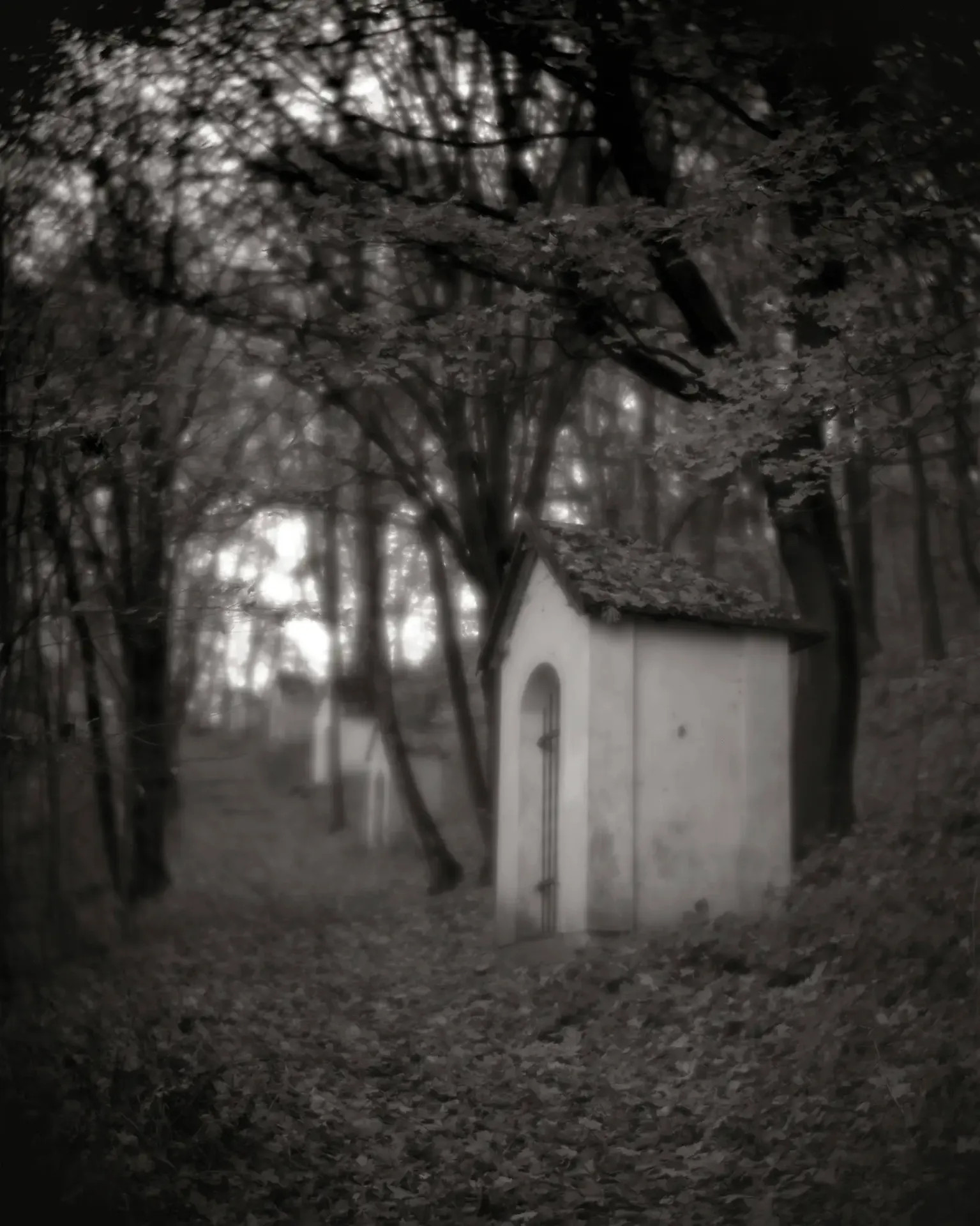
- A new fashionable era—pictorialism is a photographic style heavily inspired by painters, especially Impressionism, Symbolism and Tonalism. I don't want to copy an encyclopedia here, but for the idea: photographs are often (not always!) characterized by a flowing, blurred, dreamlike appearance. They evoke imagination, pensiveness, melancholy, atmosphere and the spirit of the good old days (which of course will never return). Many other approaches strive for the most accurate depiction of reality and claim "this is how it is." Here the center is mood and state of mind—"this is how I feel." The image becomes a carrier of state, light, and experience.
- Rebellion of artists—when something becomes too popular, a countercurrent appears of people who stubbornly and viciously howl in favor of opposition. Reminds me of someone. Once photography could mercilessly reproduce every grain of reality, part of the authors rejected the role of a mechanical recorder and began searching instead for emotion, expression and intentional difference. Only once photography could be faithful could it afford to be deceptive.
- A byproduct—what was originally a consequence of technical limitations gradually transformed into a consciously sought expressive tool. (Im)perfection transmuted into a new aesthetic ideology. Or, in other words, how to make a silk purse out of a sow's ear.
IV. The problem of two kinds
Flaws, in the name of beauty, began to be refined and cultivated. But similarly to Homo sapiens vs. Homo neanderthalensis, one path, although not worse, turned out to be a dead end. Everyone gets their turn, and the French drew the shorter straw. Any resemblance of the French to Neanderthals is purely coincidental.
Since I am about as much an optician as a Pole is a highlander, I'll try to explain this as simply as it once had to be explained to me: there were two kinds of softness—chromatic and spherical. Let's take chromatic first: light is a dumbass. It isn't just white, it's made of different colors, you just don't always see it. Take a look at the cover of Pink Floyd's The Dark Side of the Moon. Each color bends differently—red goes one way, blue focuses somewhere else, green decides to sit in between. Instead of meeting in one place, the colors gather like folks going for beer. Each ends up in a different pub, and the image is blurry as if they'd already come out. In color photography it's ugly—it creates colored fringes, nobody wants that. In black and white it's not ugly, but nobody wants it either.
Now spherical: the lens is a moron. Because it's curved, a ray hitting the center bends differently than one hitting the edge. One here, one there, contrast goes to hell, everything gets soft, scream cuts through the night. In chromatic aberration, colors can't agree where to meet; here, the lens can't decide where to send the light. It doesn't produce a colorful circus and is easier to control in use—so you can probably guess that the one who eventually had to pack their bags and leave was chromatic aberration.
Lenses that use spherical aberration, unlike the other, evil one, hardly suffer from chemical focus shift. Some designs were not corrected for the full visible spectrum, so optical flaws played a significant role. The biggest problem was axial (longitudinal) chromatic aberration, which required focus corrections. Simply put: the image recorded by the photographic material, due to sensitivity to blue and UV light, was focused in a different plane than the image observed on the ground glass. The human eye perceives sharpness mainly in the yellow-green part of the spectrum. In modern panchromatic films this problem is largely suppressed, but in orthochromatic materials, collodion and other blue-sensitive techniques, it can still be relevant.
And pst, psst—neither of these optical bastards ever gave up! These Cinderellas, mocked for a century and a half, still lives and annoys from the shadows. Spherical aberration is occasionally and deliberately used in soft-focus lenses. And chromatic aberration—that's a true, indestructible partisan. Everyone tries to drive it out of modern lenses, but it never fully disappears. Never. ¡No pasarán!

The French pilgrimage of chromaticity
Soft-focus lenses intentionally based on chromatic aberration were few, scarce and rare. Most disappeared with the arrival of color photography, because that colorful mess on the edges was apparently not desirable. And just like then, today they are, as they say in Afrikaans, So skaars soos hoendertande—rare as hen's teeth. The people of the Gallic rooster always went their own way, so most of these had no lineage somewhere else. If you want to play with chromatic softness, look for Berthiot Color, Boyer Opale or Puyo/Pulligny. Good luck.
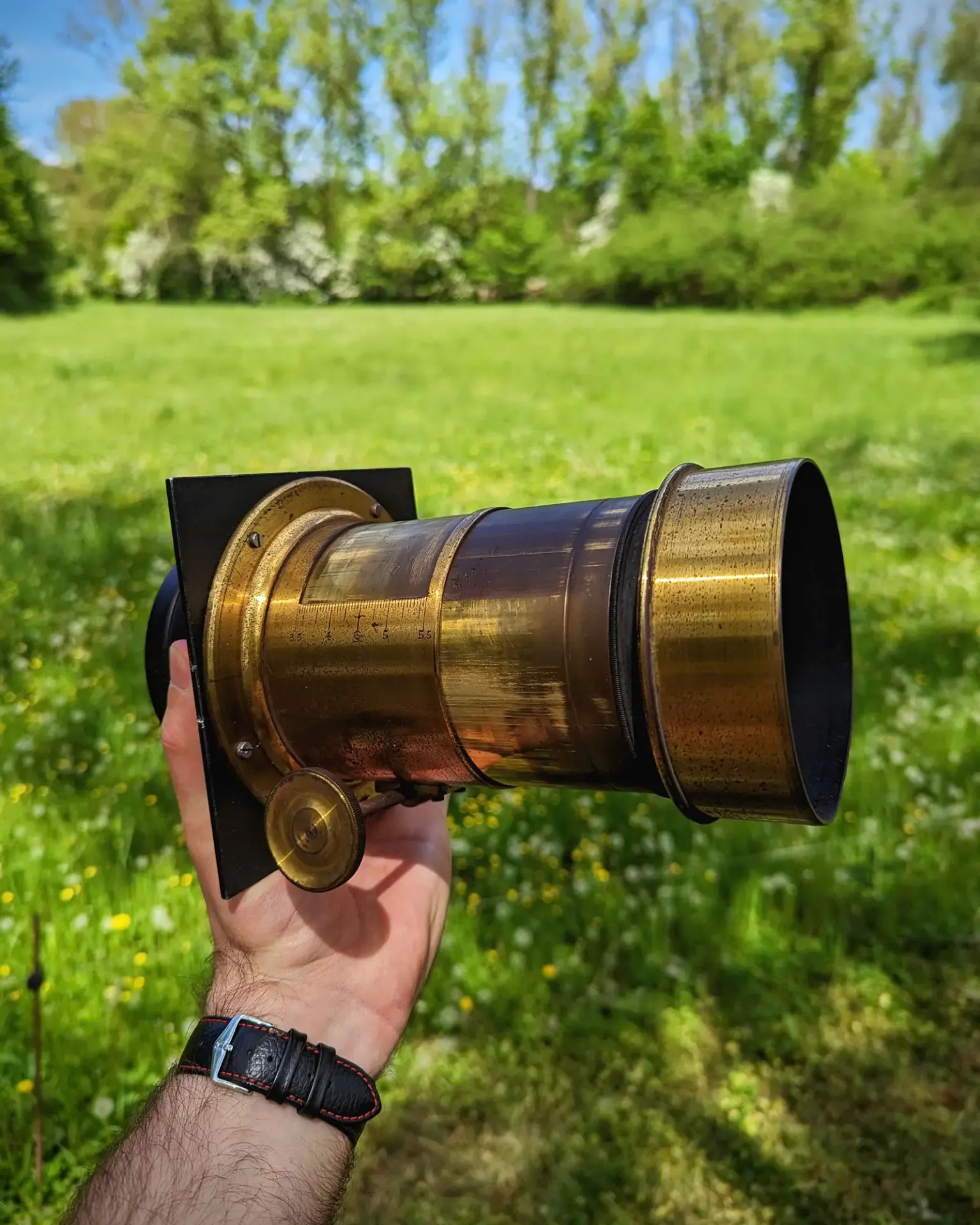
The most famous of them was the Objectif Anachromatique d'Artiste by the duo Puyo/Pulligny. The history of this brassy tube is exceptionally tangled—I'll try to shed light on it in another article. Behind it stood the hardcorely soft-minded Commandant Puyo, who really wanted it. So he teamed up with optical nerd Jean Pulligny who designed it, and then they turned to Alphonse Darlot who built it. Production later expanded and various offshoots appeared—M.G.O. (Manufacture Générale d'Optique), Derogy, Gaumont, Turillon & Morin etc. They usually had a correction scale for focus shift and were modular—the front element used a bayonet instead of a thread, allowing easy swapping of focal lengths. The lens thus resembled so-called casket sets or early zooms. Finding one is not easy. Finding one complete with all focal lenghts is not easy. If you speak a language where nothing is pronounced as written, go read more here. Hon hon Gaston, omelette du fromage.
Either way, one path, though not worse, proved to be a dead end. Chromatic error died, spherical fault took the throne. The aberration is dead—long live the aberration.
The Anglo-American path of sphericity
This train was started by Dallmeyer with his innovative Patent Portrait series. He took the original Petzval, shuffled the rear elements a bit, tweaked it and voilà—by rotating the rear element, one could now control spherical aberration and thus soft focus. It wasn't the main purpose, more of a bonus, but it didn't matter. The foundation stone was laid and chaos ensued.
Gradually, more types, variations, copies, improvements and fixes appeared—the Earth spun and lenses spuns. Women, children, everyone frantically twisting rear elements and reality went soft. And once again it was Dallmeyer who, toward the end of the century, stoked into the locomotive's boiler. The Dallmeyer Bergheim saw the light of day. John Simeon Bergheim, a mining engineer, painter and photographer, was the impulse behind the first lens in history deliberately designed for pictorialism. A visionary whose work became a bridge between two originally opposed crafts—the brotherhood of the brush shook hands with the guild of the bellows. Ideas merged and love reigned. History nearly forgot him, but that doesn't change the fact that the name Bergheim will not be erased from books nor scraped off lenses. Ladies and gentlemen, I don't mean to offend, but how many of us can say the same?
The lens itself is extraordinarily peculiar. It achieved its desired look through the cooperation of both defects—chromatic and spherical—and most models had variable and very long focal lengths. It was also a telephoto design, so focusing did not require such a long bellows. Given the extreme focal lengths, that was quite useful. It suffers from focus shift, aperture changes with focal length, the aperture scale isn't standard, focusing is extremely difficult… The interplay of all this makes it the most complicated lens I've encountered so far—before I took my first photo with it, I managed to get soaked, dry off, and get soaked again.
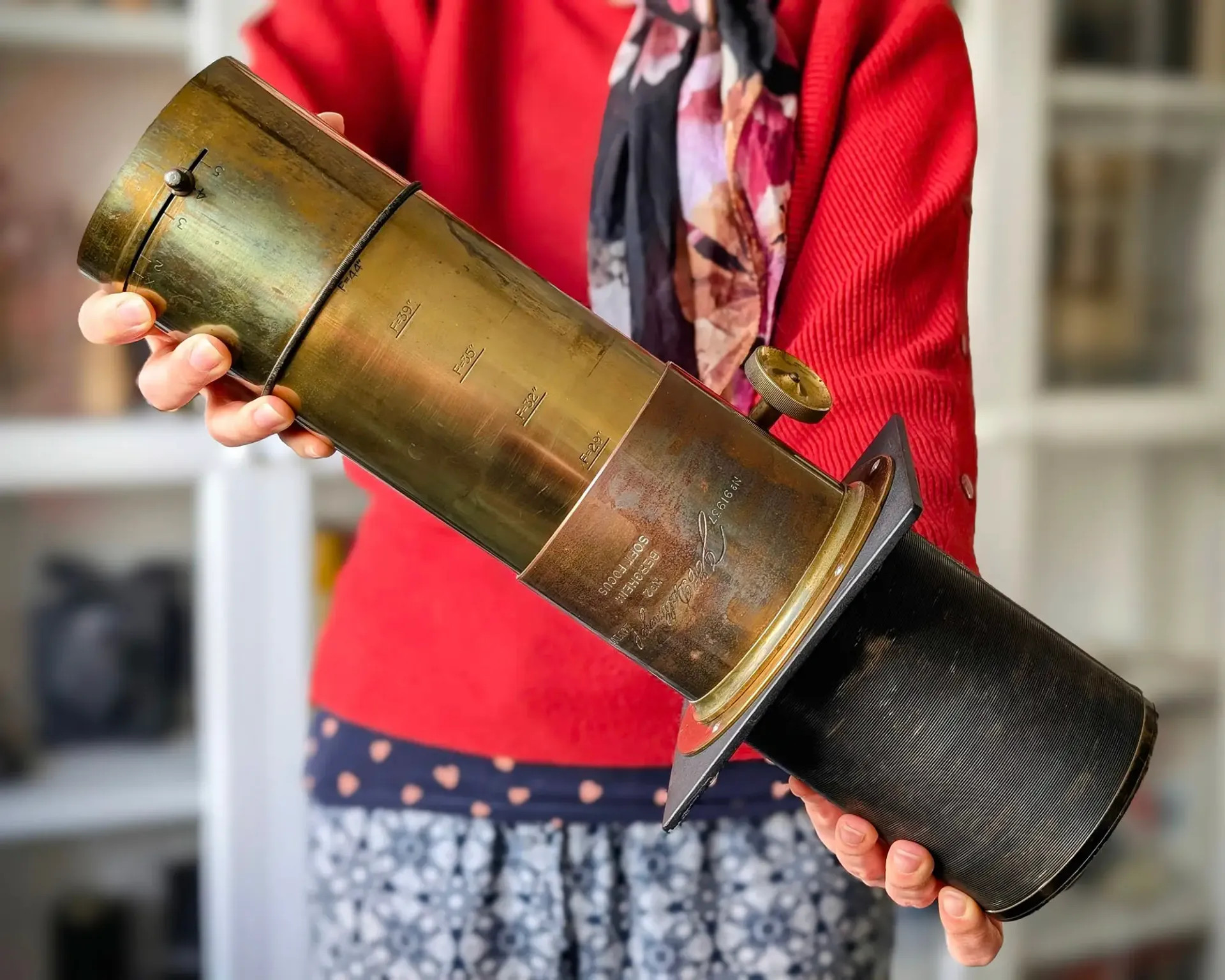
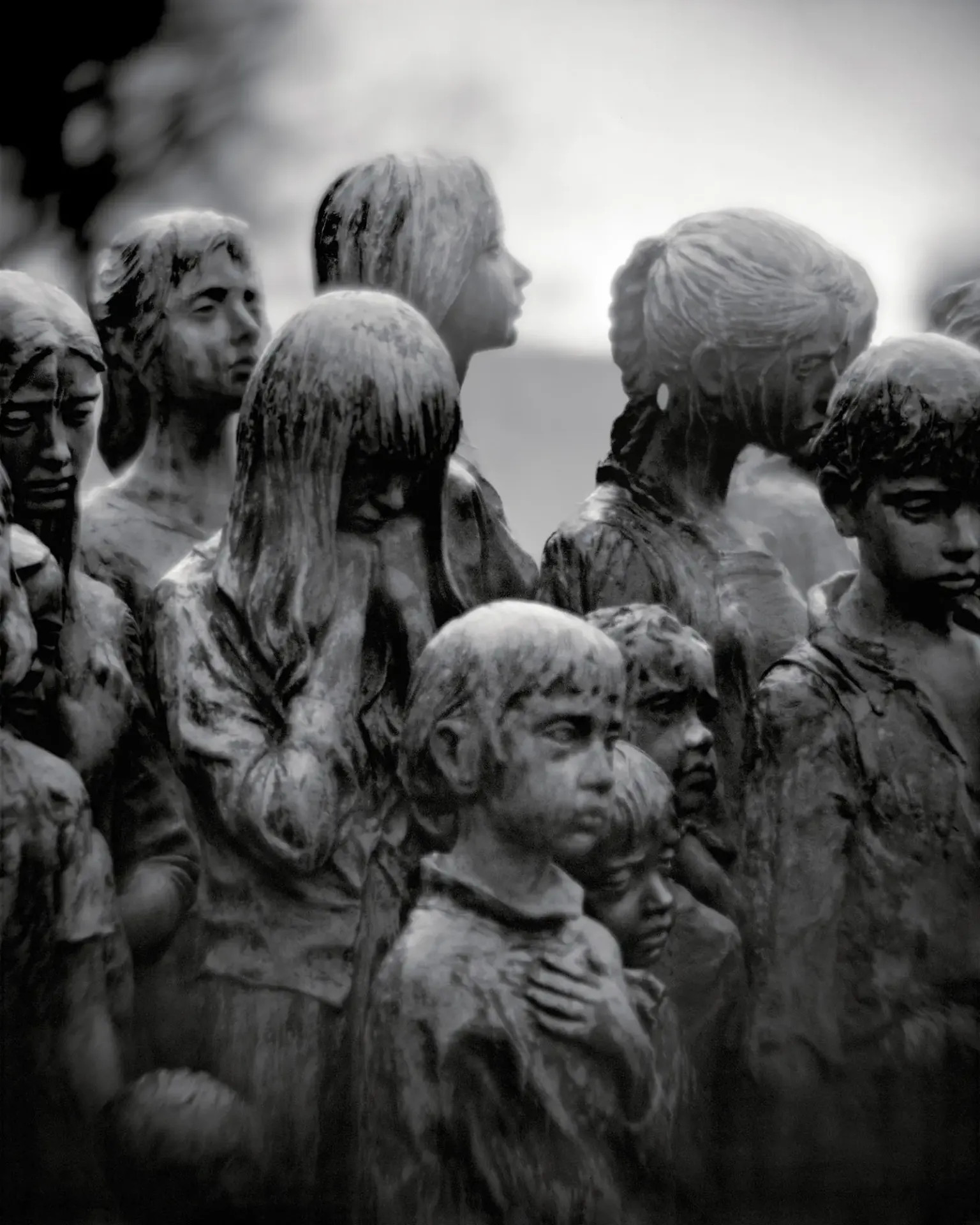
So we have softness as a bonus, softness as a purpose, and… what about softness as an accident? Allow me to introduce the Taylor, Taylor & Hobson Rapid View. This almost forgotten piece from the second half of the century of electricity was just one of many simple, cheap landscape lenses. No fanfare, no expectations. A simple, largely uncorrected rear element, aperture in front, terrible speed around f11, so so sharpness. The optical fairies were having a bad day. But then it turned out that if you unscrew a small tube and expose the bare glass, the speed increases and the lens goes crazy. From an average landscape lens it suddenly becomes a radical soft-focus lens—delicate rendering, magical 3D effect, low price, tiny size. My 325mm version, once disassembled, is only a few centimeters long—hard to believe it covers an 8x10 format.
The company shamelessly capitalized on this unexpected success and later released the Rapid View Portrait—essentially the same lens, just with modified housing and expanded aperture mechanism. Higher speed, no need to disassemble anything. The little thing turned its handicap into an advantage and successfully evolved. Someone at headquarters was probably popping champagne.
Non-epilogue
The past of artistic photography reminds me of Hegel's dialectical system—history sometimes moves forward only through the clash of opposites.
- Thesis—dreams of flawless photography. It must be perfect. Forward!
- Antithesis—a split and apparent retreat. Perfection is suddenly sought in imperfection.
- Synthesis—the realization that the ideal is achievable, but not always desirable. It is a matter of choice and sometimes coexistence.
Like many other movements, even this one experienced rise, peak and fall. Its popularity soared, until dreamy ornamentation was brutally cut short by the harsh reality of World War I. Afterward, photographic impressionism sang its swan song, but briefly. So perhaps it would be fitting to carve an epitaph on the tombstone of pictorial photography and finally ask, when soft photography died:
Never. Never!