Abrupt Albania—sore legs, smelly clutch
A country both beautiful and wild, communal and contradictory. A coastline of glittering golden beaches and indulgence, and at the same time a land of harsh mountain ranges where bears will happily turn you into Ćevapi. A dark and rich history, a bright and even richer future. This, and much more besides, is Shqipëria.

And there's also rakija. Overtaking in blind corners. Blood feuds. Ancient towns. Hospitality. Untamed spirit. A lot of lamb and mutton, fig jam. By now you can probably tell there's a lot lurking here. Time isn't infinite, and since we prefer getting to know at least part of something properly rather than skimming everything superficially, we mentally cut the country in half and head for northern spring Albania. It has to be photographed too, so I once again submit myself to the usual torment and pack my analogue junk. No reinventing the wheel. I take the same kit I used when conquering Greece:
- A square-shooting Rolleiflex SL66 with waist-level finder, one back and three lenses: Opton Di 50/4, Opton Planar 80/2.8 and Opton Sonnar 250/5.6. Along with that, my trusty Gossen Profisix light meter, a stack of black-and-white films (Ilford FP4+ and HP5+), a polarizer, three Softar II filters (because pictorialism must exist everywhere in the world, even in the Balkans!!), an ND1000 neutral density filter, a carbon Rollei tripod, and some small thingies: cable release, lens hoods, cloths, hex keys, strap and so on. A lovely five kilos. I carry it all in a cube strapped to my chest, which reliably allows me to sweat out a Mickey Mouse.
I—How do we get there?
I—si do të shkojmë atje?
Everything is planned (not too little, so we don't end up bivouacking in a ditch near Tirana and getting gnawed on by local dogs, but not too much either, so there's room for spontaneous decisions). Luggage is packed with yoktometric precision (10⁻²⁴) to fit exactly into the plane, the excitement phase is in full swing, and the phase of nervous breakdown over what we forgot and how to defend ourselves against the omnipresent Albanian mafia hasn't started yet. Ideal. Naturally, Air Albania strolls into my inbox with a cancellation notice and throws a wrench into everything. Flights cancelled. No explanation. Fuck you. Emails unanswered. Money not refunded. Well, eventually refunded, after about a month of pestering and threatening them with the civil aviation authority. Next time I'll rather walk. But the Damoclean question still hangs in the air: how the hell do we actually get there?
At this point I descend from the heavens like a Deus ex machina, blessed with youthful memories of driving an old Škoda Felicia all the way to Kosovo and through it into Albania, and dramatically raise a finger. We'll drive there in our current car! Obviously not the old '98 Felicia, we're not lunatics. This time it's a completely different machine. Only slightly newer VW Golf.
We dive into maps and pick a route. We skim Upper Hungary, cross the Paprika Sultanate and make our first stop in the land of pljeskavica and border disputes. I like Serbia and Serbia likes me. Barely does my first stiffened half emerge from our motorised carriage before I'm handed a bottle of homemade wine. With the second half, a second bottle. This is starting well. Sadly, time is limited. The more adventurous the overland journey, the more time it eats. Rested and stuffed with ćevapčići, we bypass Kosovo and detour through North Macedonia.
- The reason is prosaic. Any Kosovo border crossing from any direction is a gamble with time. We don't have enough of it to risk hours of delays and arguments with border guards. Balkan ground is hot ground. And besides, unlike Macedonia, I've already been there (and it's nice too!). We choose you, Skopje!
Skopje is a very beautiful and calm city, combining history with magnificent brutalist architecture. Especially around the Central Post Office, film rolls were flying. I knew it would be good here, but I didn't know it would be beautiful. Again, no time to linger. In the morning we head for the next stop: Albanian Krujë. We choose the route through Mavrovo National Park and the Debar crossing. It's longer, but the road is worse. And beautiful! We start torturing the car for the first time, winding our way up in convoluted climbs. Detours, backtracking, maps that lie. No regrets though, the views are breathtaking. Snow appears. We stop, stare, shoot, absorb panoramas, climb up, drop down. An hour disappears photographing flowers on an endlessly long, peaceful limestone plateau somewhere near Galichnik. Then on we go. Down, up, forward.
Everything goes well until it doesn't. Albania doesn't welcome us with open arms, but with our first fuck-up. Or rather, to be fair, we're not even there yet. The car protests and stops being self-propelled in one of the worst possible places on Earth: the no-man's-land between North Macedonia and Albania. At the arse end of the Balkans. The EU far away, God high above.
I'm an automotive idiot. Cars have usually three pedals, a stick with numbers between the seats and a steering wheel in front of me. That's the extent of my knowledge. And the gear stick stopped gear-sticking. You could only shift with the engine off, so several hundred meters of painful crawling in first gear awaited us. Naturally uphill. Anyone who's ever stood at a Balkan border knows you inch forward in inches. The Golf suffered. And if you start moving 0.00001 seconds later than socially acceptable, the honking cacophony behind you begins. After googling, swearing, realising no one is coming for us, and accepting that first gear will get us to hell but not to Krujë, we began to reconcile ourselves with a new life between states. Asphalt nomads, surviving on washing windscreens in a few hundred metres of no-man's-land.
Then suspicion struck me. The clutch pedal felt a bit lower than usual. I tried lifting it with my foot and pushing it back up. Miracle. The bastard had probably jammed halfway and prevented proper shifting. Cars people are surely slapping hubcaps against their foreheads at how obvious this was from the start, but I was proud of myself. We weren't staying between two fluttering flags.
II—will the car survive?
II—si do ta përballojë makina?
We flash our passports, shift into second! Third!!, and soon the ancient city of Skanderbeg appears ahead of us. Krujë is aggressively vertical. We drive all the way up. Right up. Very up to the fortress. No photo, video or story can truly convey the experience of driving through sharply angled, steep alleyways packed with obstacles, tourists, stalls and assorted vehicles. We're dizzyingly high, everything is absurdly narrow, and it all screams that cars absolutely should not be here. Flashbacks of driving in Thailand and Greece pop up. But we make it and look down toward the sea. After a welcoming rakija the day ends in the sleep of the righteous.
We're woken obscenely early by the muezzin's call mixed with turkeys grumbling under the windows. We crawl out of bed and finally see in daylight what was hidden by darkness the night before. The castle tower wasn't wrapped in bungee cords last time I was here. Hopefully it holds. Otherwise everything's the same, except the local kebab, which has been replaced by a betting shop. Krujë is beautiful. Or rather... its upper part, from the bazaar upwards. The rest is a collage of corrugated iron houses (along with cardboard, the most important building material in the world) and horrifying tourist mega-hotels. Together with the Sarisalltik shrine above the town, it's perfect for a day. And then f off somewhere else.
In Albania, every second thing is named after Skanderbeg, national hero, military commander and unifier. Krujë is his birthplace, the castle originally belonged to his father, there's a museum inside. You can't escape him. Oh, and by the way, they even named a Waffen-SS mountain division after him.
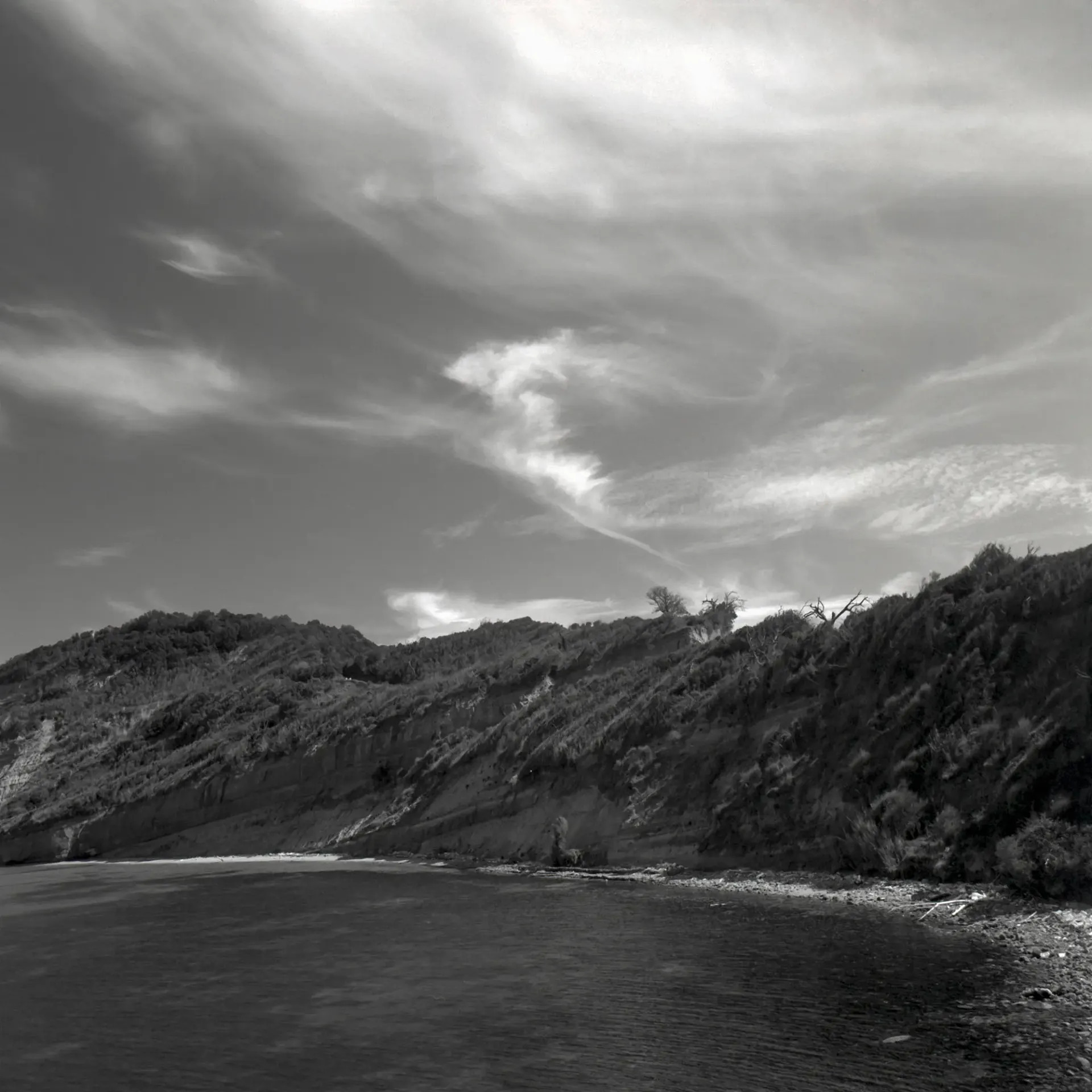
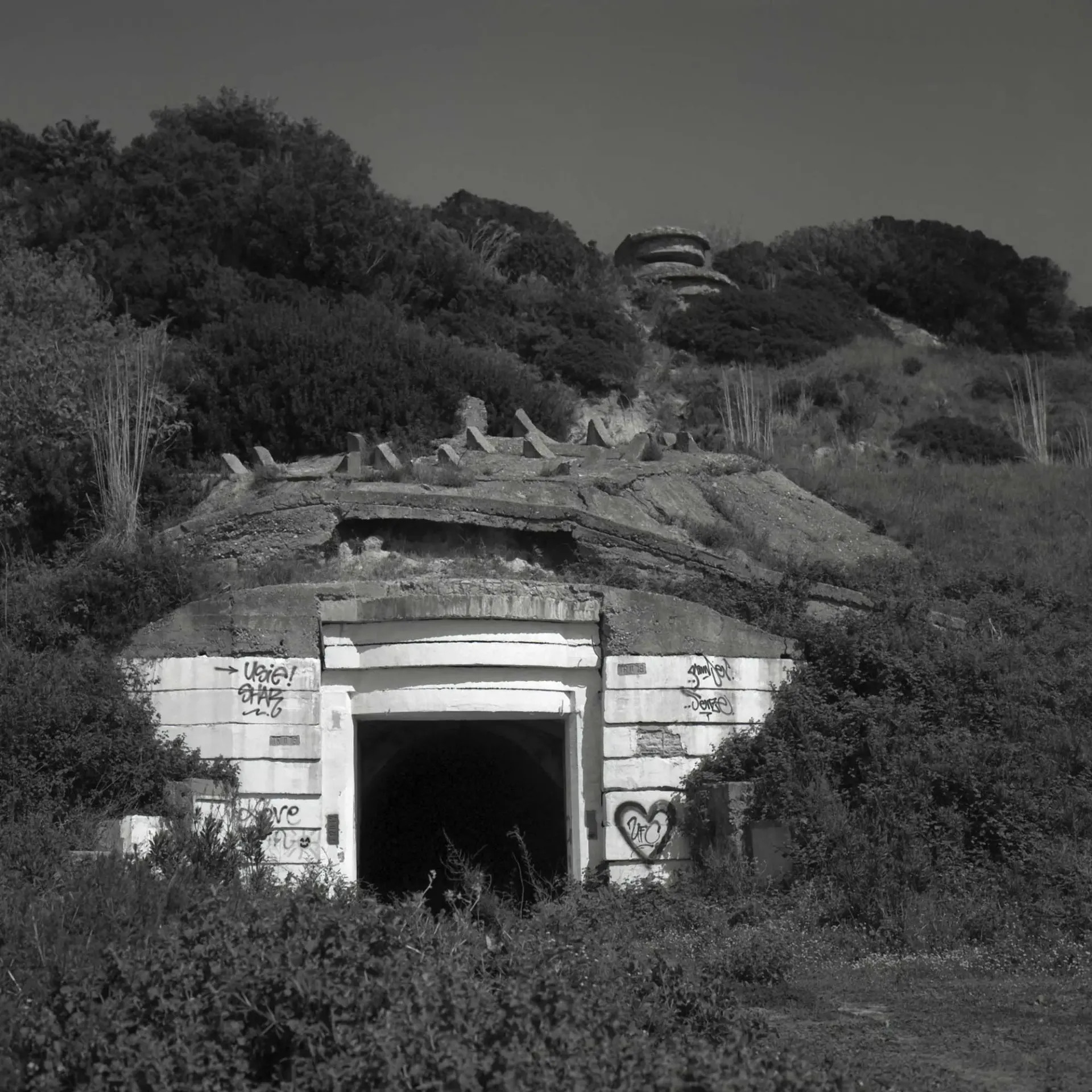
"F off somewhere else" for us meant a stop at Cape Rodon, also known as Kepi i Rodonit, also Kepi i Skanderbeut. A narrow peninsula stabbing into the Adriatic Sea, topped, unsurprisingly, by Skanderbeg's castle. The road is beautiful, the views are outright gorgeous. The asphalt, however, is already hungry for your oil pan, and the coastline is littered with trash. And bunkers. Big, massive piles of bunkers.
For over forty years, Albania was ruled with an iron fist by Enver Hoxha. And this Enver was a lunatic. He forcefully secularised the country, demolished churches and mosques, destroyed anything traditional, symbolic, outdated or politically inconvenient. Albania became the first officially atheist state in the world. After the Warsaw Pact invasion of Czechoslovakia, paranoia escalated further with the spectre of invasion. Since everyone was surely allegedly itching to attack Albania, Hoxha ordered the construction of around 175,000 bunkers. One bunker for every fourth inhabitant. No joke. Time and erosion are eating them alive, but they're still everywhere. Along the coast they stretch like a concrete necklace. Owning a concrete plant back then must have been a hell of a business plan.
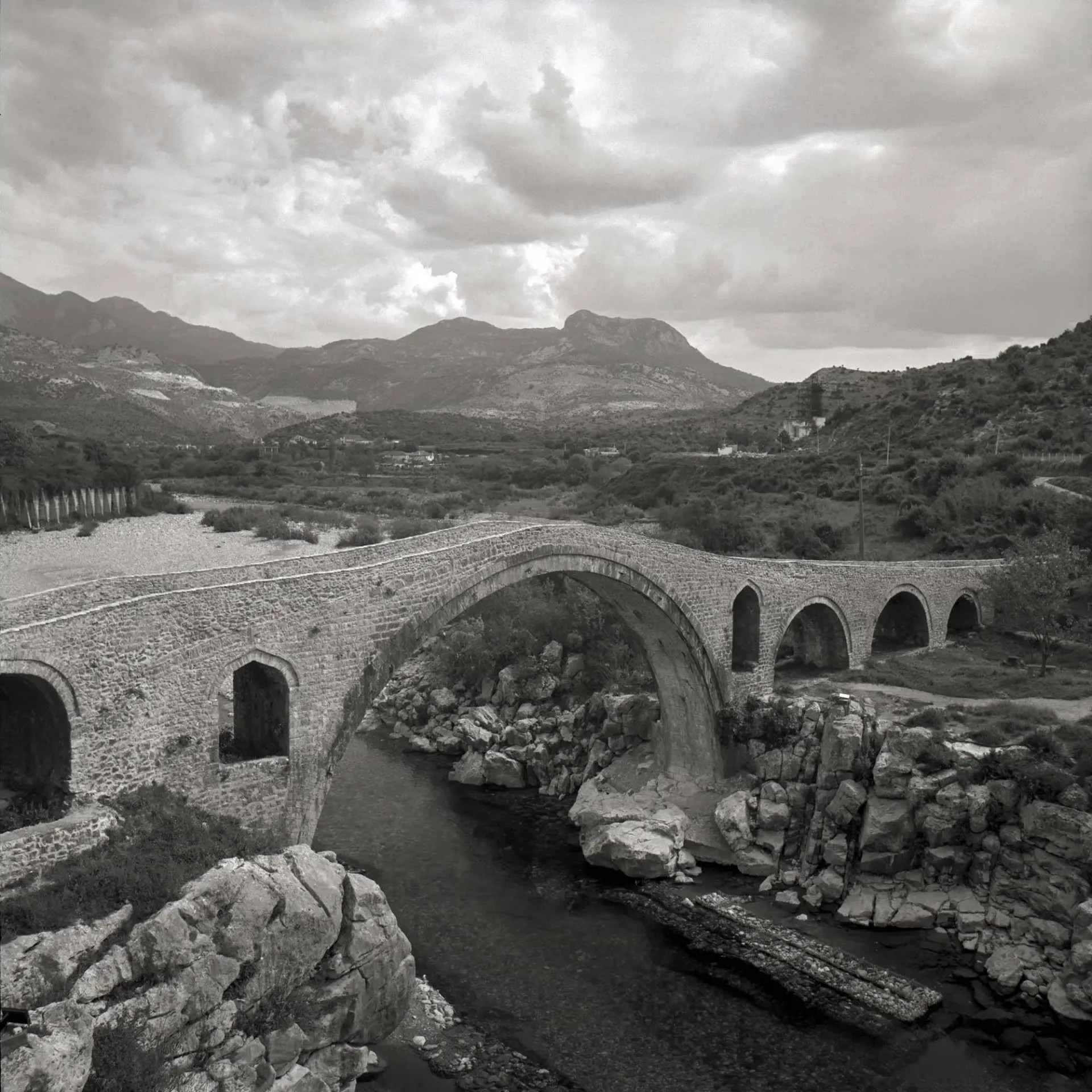
We turn north and hop across the pompous ruins of the Illyrian fortresses of Lezhë and Rozafa, spice it up with the Ottoman Mesi Bridge (which, incidentally, has a fantastic view from the ugly modern bridge right next to it), and begin massaging our legs and the car's tyres in preparation for the golden nail of the trip. The largest and highest chunk of the holiday. The Accursed Mountains.

We aim for the remote Kelmend region, currently separated from us by several thousand vertical metres of twisting serpentine roads and falling boulders. Most concerns are dispelled by a local man who assures us that we have "the best car in the world!" and that he would entrust his life to a Golf without hesitation. I have no trouble believing him. The car is absurdly popular here and remains repairably old-school. Anyone except me can fix it with a rock and duct tape.
Spare parts roam and lie everywhere. The Albanian vehicle fleet consists, roughly speaking, of one third decade-old Mercedes cars which, judging by appearance and odometer readings, have driven to Mars and back at least once. The remaining two thirds are VW Golfs. And two thirds of those are the same silver colour. Albania is a rolling retro advertisement for the German vroom-vroom industry.
III—will we survive?!
III—po ne si do t'ia dalim të gjallë?!
Our accommodation isn't far, so we park the wagon and spice up the day with a walk to a nearby waterfall (Albania is a real mecca of waterfalls!). According to maps, signs and comments, there are two routes. One "relaxed", and one "lined with the corpses of overconfident tourists". Despite being extremely hiking-fit thanks to dog-walking around housing estates and frequent trips to the pub behind the house, we decide to start easy and choose the relaxed option. Doubts strike immediately within the first metres, when I find myself scrambling above a cemetery up an almost vertical rock face resembling some damn Albanian El Capitan. Snakes follow. The path clinging to a rocky drop like the stairs to Cirith Ungol. Rain. River crossings. A wet, half-collapsed bridge over a raging stream, covered in moss.
This is where the trail ends. The waterfall is just around the corner, but I realise with some astonishment that neither of us is a gecko, which is besides Spider-Man probably the only creature capable of crossing this without plummeting into the bowels of the Earth. I threaten the idiot who marked the trail incorrectly with words and trekking poles, then curse myself for not checking contour lines in advance. But hey, at least the return route is the other one, with a non-zero survival probability. No need to scare the reader with suspense—I survived and I'm writing this article. Both routes were, in any case, wildly beautiful, raw, deserted and full of waterfalls. You don't even need to reach the main one. It struts itself from afar. :)
We drive over an artillery range masquerading as a road and end up at our base camp in Lëpushe. Mountains ahead. Mountains left. A slope, an excavator, then more mountains to the right. Behind us, manure, pigsties, pigs and also mountains. Over the next few days we slowly conquer peak after peak in a completely empty, jagged landscape where only the whims of the weather keep us company. And briefly, one fire salamander. Strength fades. On the summit of Maja e Grebenit, after the ascent, I feel utterly indifferent to everything. Approaching thunder changes my mind fast. I frantically finish shooting, pack the tripod, stash trekking poles and retreat downhill in a cautious, crouched sloth-run. Prokop Diviš did enough work already, so I have no ambition to continue his research about lightning rods. I'm grateful I didn't turn into a human torch during my previous Balkan visit—given the amount of alcohol in my bloodstream back then, I still don't understand how I didn't spontaneously combust like the mayor of Warsaw in 1546.
Our first no-go stop is from the peak of Maja ë Vajushes. A literally breathtaking route leads us across steep snowfields onto a ridge with the summit crown in sight. Except there's no path in sight. I suspect it's buried under snow on a narrow, steep slope of melting slush. Crampons are about as useful here as a leg to a snake. Time is running out, fog rolls in, weather worsens, wind picks up. I'd rather be a living coward than a dead hero (idiot?). We skirt the summit and loiter a bit, and without warning or expectation the mountains reveal (perhaps as a reward for not trying to defeat them at all costs?) what may be one of the most beautiful panoramas we've ever seen. The Montenegrin rock walls of the Karanfili range.
We say goodbye to the local salamander and trade isolation for an overdose of people at the next stop: Theth. Until fairly recently, this was a secluded village under the iron grip of the mountains, reachable only by rattling off-road vehicles. Now, together with its new road, it has become a full-blown tourism stronghold, complete with all the associated nonsense. The grim fact is that plenty of people in shiny cars drive all the way here just to take a photo in front of the church and then fuck off back where they came from. The cheerful fact is that plenty of people in shiny cars drive all the way here just to take a photo in front of the church and then fuck off back where they came from. And the further you move away from the village, even by a small distance, the more directly proportional the decline in fur-coated ladies and tight-shirted gentlemen becomes. There isn't all that much to do in the village itself anyway, apart from gawking at the famous church and the local tower fortress. You can also briefly entertain yourself by observing the local fauna rummaging through rubbish bins. Otherwise, get out into the surroundings.
A structure like the Kullë e Ngujimit is a very interesting thing indeed. But in order. The Kanun is an ancient Albanian set of unwritten rules. A mountain law code from times when the arm of state power was too short and remote regions preferred to sort things out themselves. You violate the Kanun?
Gjakmarrja starts. Blood feud. Let's say a neighbour envies another neighbour's handsome sheep and murders him. The victim's family has the "right" to respond in kind. An eye for an eye, a tooth for a tooth. The Damoclean sword didn't hang only over the actual perpetrator, but over every adult male in the family. It wasn't just murder. Rape, insults to honour, debts, kidnappings and God knows what else also counted. For his own good, the perpetrator would gather himself and the other men and go rot in a
Kullë. A fortified stone tower built by families or villages for cases of Kanun violations. Women were not normally imprisoned in Kullë towers, they were not expected to rebel against decent morals. And if they did, it was such a disgrace to the family that it would be "handled" at home. In rare cases, a male relative could go into exile as a substitute. Entire families sometimes lived together in the towers, supplied by relatives from outside. Even for years. The towers often had firing slits to fend off vengeful attackers, and the fate of the exiles depended entirely on whether those outside managed to reach an agreement. Or not.
The result was families locked in towers because outside someone might shoot them over an uncle who stabbed a cousin with a pitchfork. Or because a cousin stuck something else into someone else's cousin. A fascinating and complex tradition that probably no one misses. That said, blood feuds are still practised today. Just without the towers. Hoxha dealt with those, Kullat (plural of Kullë) are now rare as saffron.
There's no shortage of things to do around here. Enough for an entire travelogue. But among everything, besides an encounter with a nose-horned viper (Vipera ammodytes) and discovering draught Budvar, one place stands out—Qafa e Valbonës, the Valbona Pass. In summer, it allows passage into the Valbona Valley and on into even more remote areas where a fox will bite you. Above the pass are rocky outcrops offering spectacular views of the valley and the brooding mountains on either side. At the time of our visit, however, there was still snow in the pass and valley, making the route impassable.
Not so for one insane Russian. At one point he crawled up on all fours from the depths of the steep pass below us. Scraped and bleeding hands, sweatpants and a hoodie. He informed us that the route was not very good and that he probably wouldn't be going back. Immediately, a scene from the end of the first Back to the Future popped into my head, where Doc Brown declares: "Roads? Where we're going, we don't need roads!" I limited myself to unbelieving stares and head shaking, a nearby German tourist limited herself to asking: "Are you mental?"
IV—and how do we get back?
IV—po si kthehemi mbrapsht?
So long, Theth, mountains, Albania. Next stop: Sarajevo. It's only a bit over 300 kilometres, but in elevation gain it's nearly the equivalent of Mont Blanc, and at least initially the route profile looks like a set of tangled earphones fished out of a pocket. We get up at dawn and I stuff the car as if twelve people were travelling. We wave one last time to the dogs peering out of bins and head to a city where they shot Franz Joseph Number One.
In Podgorica I flood myself with caffeine, and before Bosnia and Herzegovina a very pleasant driving surprise awaits us. The Piva River canyon with Piva Lake. The road is carved into the rock, winding above a deep gorge below and beneath the towering Dinaric Alps above. If you sneeze and slip off the road, they'll find you only with binoculars. The stretch runs for dozens of kilometres, threaded through a series of rock tunnels and it's stunning. Be careful in the tunnels, they're unlit. That doesn't sound too bad, but on a bright sunny day it feels like suddenly driving into a sack of darkness where you can't see a shit. Exiting is the opposite—like stumbling half-asleep to the toilet at night and switching on the light straight into your face. The tunnels are short and frequent, so parts of the drive feel like passing through a strobe light. Not exactly epilepsy-friendly. But metro drivers will feel right at home.
Entering Bosnia and Herzegovina is easy to recognise. Apart from the border crossing, the beautiful road instantly turns into something so full of holes so deep, that we can clearly identify Bosnian geological layers. At a speed of one decimetre per hour we limp into Sarajevo, where another surprise awaits us. What the city lacks in width, it makes up for in height. Areas outside the centre are brutally vertical and narrow. Choose your accommodation carefully—even if everything looks close on the map, the climbs and descents rival a trek to the Valbona Pass. I would not want to do grocery shopping here. Otherwise, Sarajevo is a pleasant surprise. City live their own lives and there's plenty to do. For instance, you can be an idiot and walk 25 kilometres on cobblestones and asphalt in flip-flops, then regret having feet in the evening. Any resemblance to living persons is purely coincidental.
If you set aside the typical tourist attractions, dark tourism is also an option. Traces of the war and the Serbian siege don't require much searching. A particularly unusual experience is the hill above the city. A cable car leads up, and besides nice views and a walk (though not too far. Surrounding forests are reportedly still not fully demined), you'll find an old bobsleigh track. It was built for the 1984 Winter Olympics and later used by Serbian artillery to shell besieged Sarajevo. The track is accessible and can be walked in its entirety.
- Connected to this are the so-called Sarajevo Roses. Where a mortar shell killed someone, the shattered asphalt was filled with red wax. These crimson scars, resembling bloody flowers, number in two hundreds across the city.
- The main boulevard, Zmaja od Bosne, is nicknamed "Sniper Alley." Serbian snipers hid in high-rise buildings and tower blocks, and the street became notorious as a civilian killing ground. Many façades still resemble sieves.
We coast out of the city and spend our last night on the Tihany peninsula by Lake Balaton. Scented with paprika and lavender, we wander around, mentally preparing for the final stretch back to our beloved city of a hundred spires. As the penultimate experience, we treat ourselves to an early wake-up and dawn over the lake. As the final experience, I treat myself to be grumpy at some nitwit with a buzzing drone at dawn over the lake. Then I switch to zen mode, and before you know it, we're home. The car made it. We made it. Departures are long awaited, returns are happy. And that's how it should be.