#7 Wollensak Raptar
Lenses with razor-sharp rendering are a dime a dozen, and plenty of them can sketch out a pleasant bokeh. Finding a piece with real character — whatever that even means — can be tricky, but doable. But what about a specimen that bundles all of that together and adds a downright badass name on top? Step right up and behold the Raptar 302mm f6.3.
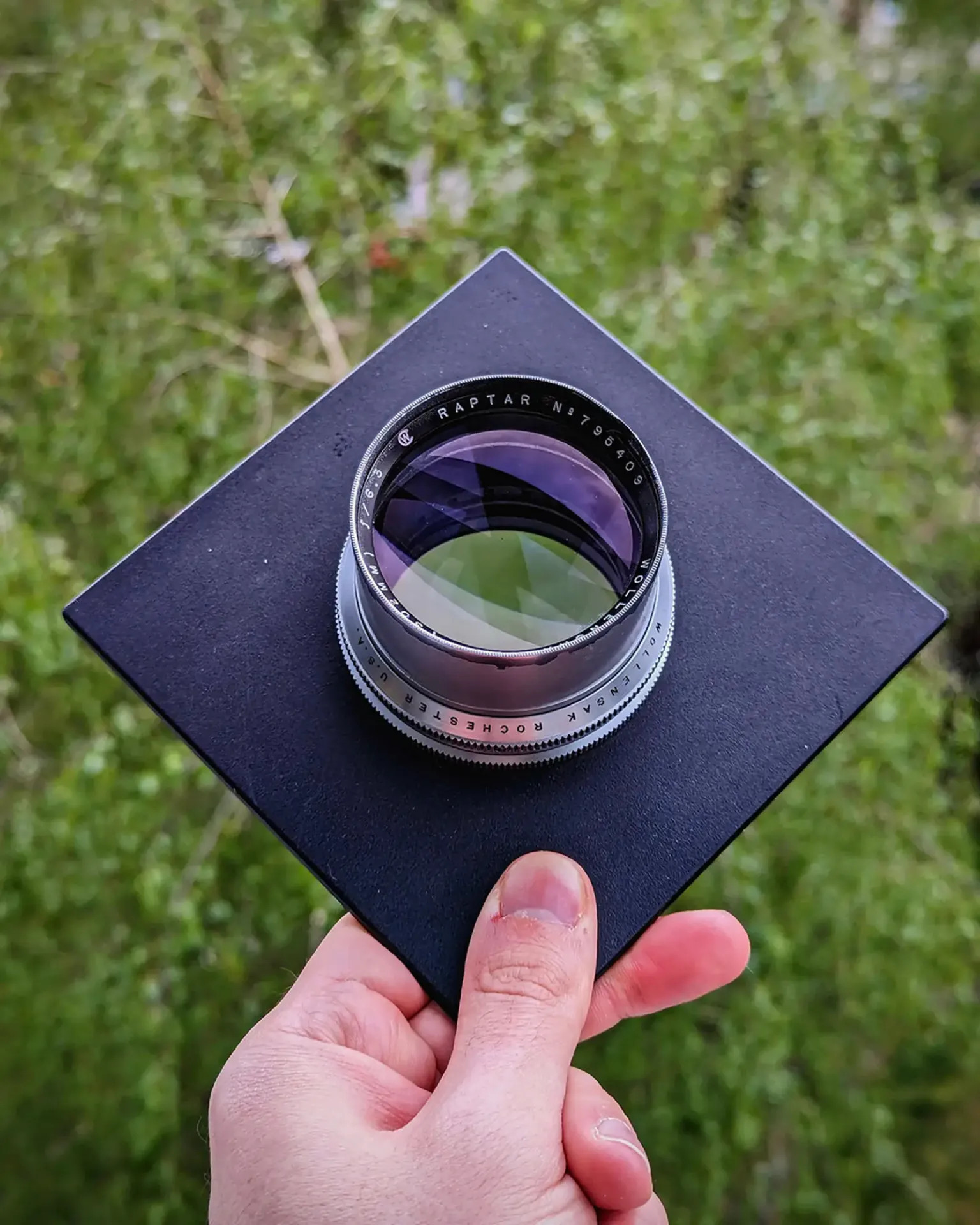
Who would expect that from such a relatively slow lens with a modern-looking exterior, right? Still waters run deep, don't judge a book by its cover, keep your cup half full, yada yada. Enough wisdom. The advantage is that nobody really barks after these Wollensak lines, so you won't be bidding at 3 a.m., pawning off your house and kids in desperate pursuit. The downside is that they're still as rare as hen's teeth. Personally, I've never seen a second copy, so whatever.
- The data is not easy to find, but I rolled up my sleeves and dug into the depths of the dark web: it is a Series IV No.5, 12" focal length, later corrected to 11.875", or 302mm. Production was briefly between 1947-1951, the revised piece even only from 1949 - so the appearance of modernity is quite deceptive.
Update: this is the rarest and final iteration of a much older lineage. In 1912 came the Vinco (and Vinco-Anastigmat), up to 1914 in a slower f/6.8 version. In 1920, Vinco changed clothes and reemerged as the Velostigmat Series IV. And finally, in 1947, the line concluded as the Raptar Series IV. Fascinating stuff!!
So feel free to lust after the Vinco and Velostigmat IV as well — apart from possibly missing later anti-reflection coatings, they're basically the same thing. Thanks to my findings, your shopping maneuvering space and financial risk have just expanded significantly. Sorry not sorry.
The name "Raptar" came from a public "Name This Lens" contest, won by one Mr. Templin R. Licklider Jr. from Bloomfield Hills, Michigan. He was inspired by the sharp talons and keen eyesight of birds of prey. Congratulations with an 80-year delay, Mr. Licklider — the name is pretty damn tough. Also-ran names included the bland "Colotar" and "Micronar." I can only recommend the extensive info available here.
Most Wollensaks lying around are shorter focal lengths, often used as cine lenses or for copy and enlarging work (Enlarging Raptar, Tasope, etc.). Getting the version meant for actual large format photography is quite a chore, same as with its predecessors Velostigmat/Vinco. One indicator, as seen here, is the presence of a "W" hidden inside a "C" on the front ring — Wollensak's "WOCOTED" mark for their advanced anti-reflection coatings. These appeared only rarely on lenses not intended for photography. You can also spot them by the lens surface tint: bluish to purplish and, in the right light, downright sexy. But beware: the coatings weren't applied consistently, and not every post-1947 lens has them.
Alongside the sensual coatings, this one also sports an unusual silver-chromed brass finish, which will surely awaken inappropriate feelings in more than one photographer. The lens is very light and compact, ideal for field work. The many-bladed aperture is just a little bonus on top.
I'm a man of wide-open apertures, and the mere mention of the f/64 group makes me wave my hands while everyone wonders why my eyes are huge and I'm foaming at the mouth. So it's a lovely trait of the Raptar that it is unbelievably — I repeat, unbelievably sharp wide open, with strong contrast, great depth of field and bokeh. A rare combination that makes it a truly universal piece of glass for nearly any situation. If I had to nitpick, it would be the slightly slower f6.3 speed — a mild annoyance for portrait work, though with group photos you're stopping down like mad anyway.
Much like the Heliar, I take it when I've got no idea what awaits. It takes no space in the backpack and doesn't murder your spine. It especially shines with larger groups thanks to its flat field and edge-to-edge sharpness. That's mighty handy when you've got several rows of photo-hungry crowds behind one another.
And let it be said in honor of this sharp-taloned beast that it practically refused to let me take an out-of-focus picture, no matter the conditions — and trust me, I gave it plenty of chances.