#13 Eidoscope
L'Eidoscope ne photographie pas, il dessine!
This is a transcription of a historical interview discovered among a bottle of red wine, a mouldy blue cheese and the legless skeleton of a frog during the restoration of the House of the French Crown. Uncolourised.
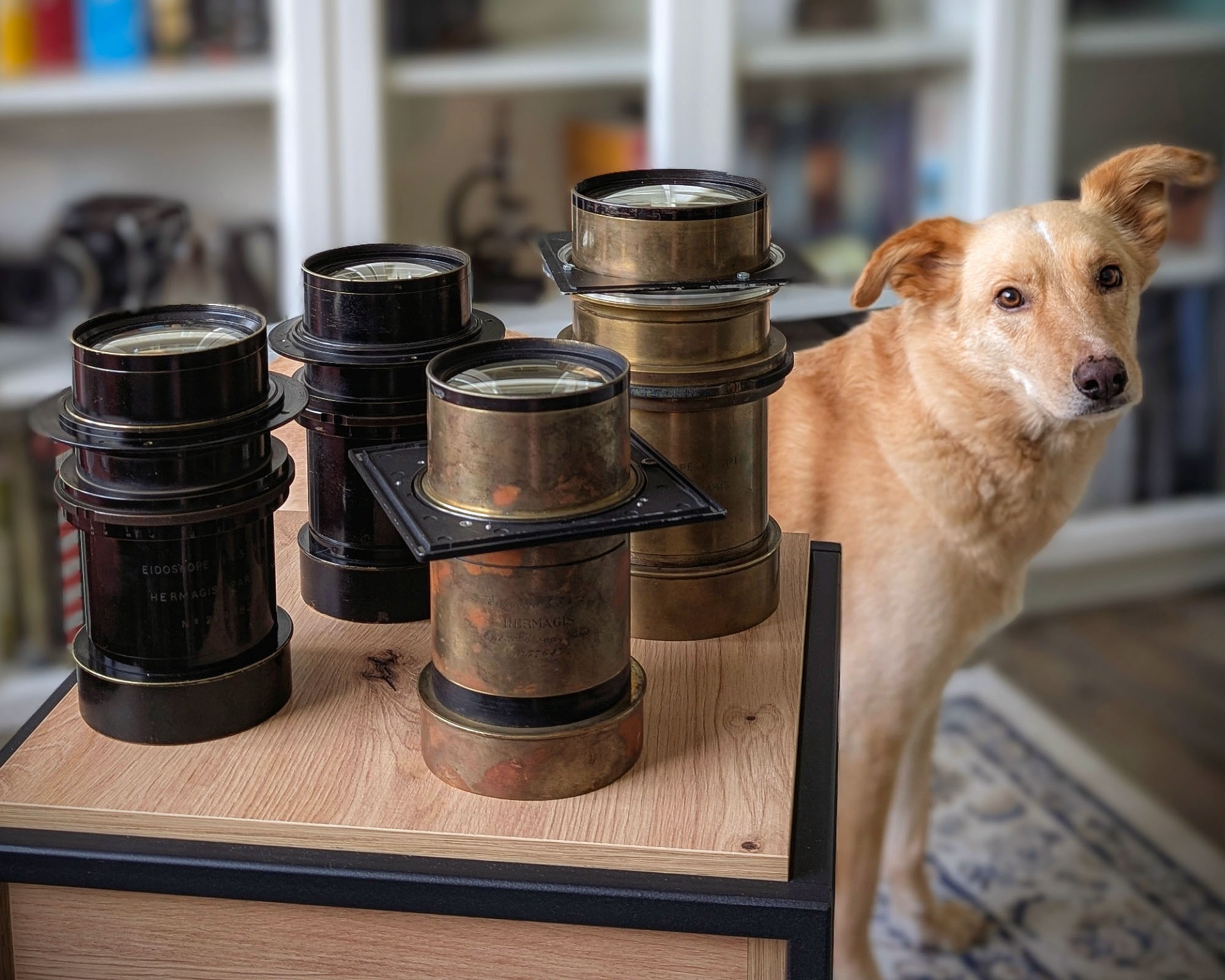
Editorial Office: Welcome to the Lands of the Bohemian Crown! It is our honour to host an emissary from the very bosom of photography here, in one of the centres of Central European artistic life.
Eidoscope: At last, in the homeland of Drtikol, Novák and Sudek! The latter may still be dragging wooden shoes about, but I foresee a splendid future full of wooden cameras for him! *A beer lands upon the table.* Merci. And have you any wine?
EO: Perhaps. But enough about us! Pray tell us something of your soft brass mission.
E: Avec plaisir. I am the Hermagis Eidoscope. My journey began in Paris in the year 1903. They call me objectif à flou artistique, an artistic soft-focus lens. I was deliberately bred for impressionist photography and walk in the footsteps of such giants as Puyo and Pulligny or the Dallmeyer Bergheim. I would gladly recommend a fantastique article about soft-focus photography by Negative na cestách, but alas, it shall not be written for more than a century yet.
EO: You claim to be an artistic lens. Is that not merely an elegant way of excusing incompetence and passing off even the least successful result as creative intention?
E: Anyone with eyes and a diaphragm ring may achieve sharp focus. With ordinary optics, the photographer sees precisely what he is doing, and should a photograph fail, the cause is usually easy enough to identify. With pictorialist lenses, matters are more complicated, for their peculiar character is greatly influenced by circumstance. The outcome is less predictable, and the boundary between a compelling artistic effect and a failed photograph is exceedingly thin. Despite the widespread belief that they merely facilitate the production of purposeless artiness, creating a truly fine pictorialist image is often more demanding than making a technically flawless sharp photograph.
Without experience, their nature is difficult to divine, and when the uncooperative laws of physics intrude, perhaps in the form of chemical focus, it becomes evident that a convincing result requires considerable mastery of the entire process. One must see the result beforehand, for one shall not perceive it with one's eyes.
EO: Then your soft disposition is founded upon error and chance?
E: Upon error, yes, though it is no simple matter to determine what truly constitutes a defect. I prefer the term controlled illusion. Let exactitude and precision be left to accountants and engineers; the artist ought to court impression. And that impression I hold firmly in hand. Not for nothing does my name derive from the Greek words εἶδος (eidos—form, appearance) and σκοπέω (skopeō—to observe, to contemplate). In other words: perceive the whole, place form above fact, capture the essence. I shall attend to the embodiment of the idea. How much chance and unpredictability may contribute is, in the end, up to you.
EO: Greek may have erected the pillars of science, but is that supposed to persuade the customer to purchase your optical cabaret instead of the precise scalpels of modern optics?
E: Permit me a small prophecy. Alongside the great city, I glimpse a future in which flawlessness becomes the norm and everything is suitably magnificent, beautiful and sharp. Whether we wish it or not, a certain lifelessness accompanies it, followed perhaps by boredom, emptiness, and weariness. Man shall reach the heights only to desire a voluntary descent. Alarm at what we are capable of will drive us back toward the familiar past. After all, what you cherish most in those dear to you is not perfection, but their faults and little sins, their individuality and peculiarities; those very things that make them who they are. Defects are mankind's most beautiful privilege. Why should the same not apply to a lens?
EO: Please tell us more about the technical details.
E: I may be found in many focal lengths and variations. From those intended for carte de visite, through half-plate and full-plate sizes, all the way to mammoth formats, where our largest specimen serves: the No. 0, 635mm f/5. Few shall ever make use of it, and I suspect you will not encounter one with any ease. My earliest selves may be recognised by their golden brass and waterhouse slots. In time, an iris diaphragm and perhaps an elegant blackened finish are also planned. But who can say? Perhaps, in some distant future, we Hermagis shall be taken over by the Société d'Optique et de Mécanique de Haute Précision Berthiot and converted to blackened aluminium. The advantage of lightness over brass is obvious enough, yet the soul shall lose some of its lustre. Beautiful things are often heavy.
EO: How do you distinguish yourself from other artistic lenses? Why should one choose the Eidoscope in particular?
Eidoscope: There is both a technical and an artistic aspect. Let us first satisfy those of a technical disposition. Compared with my predecessors, I excel in speed—an aperture of f5 is a value worthy of the modern age. Certainly, Mʳ Petzval remains unmatched, yet the price of his virtues was collected elsewhere.
My construction employs a pair of achromatic doublets which restrain chromatic aberration and undesirable colour fringing. At the same time, however, I leave ample room for spherical aberration to reveal its strengths. At full aperture, these qualities are most pronounced, while stopping down gradually diminishes their influence and renders the image sharp and precise. Furthermore, both the front and rear groups may be used independently thanks to the symmetrical Rapid Rectilinear design, granting the photographer several distinct configurations with differing focal lengths and rendering characteristics. It is therefore no exaggeration to say that within a single brass barrel I conceal several lenses, each with its own manner of expression for whatever need may arise.
We have also innovated the aperture scale. Instead of today's confusion of competing systems, we have adopted our own approach and seek to bring order to the matter. Following the maximum aperture marked f5 come values such as 6, 7, 10, 14 and 20, corresponding to the actual aperture values and requiring no calculation. For in the Eidoscope, the diaphragm serves not merely to regulate light and depth of field, but above all to control the intensity and character of the artistic effect. This système permits a far finer degree of control, transforming the experienced photographer into a conductor commanding an entire orchestra. I am quite certain this innovation shall find favour.
EO: Novel and progressive indeed! It remains only to win over the artists.
E: My true strength lies not in technical design, but in the manner in which I transform the photographic scene and unite precision with intention. I sketch an image that retains its descriptive character whilst remaining mysterious and fleeting. Bright passages are soothed by a characteristic shimmer and transitions between light and shadow assume an allegorical, almost otherworldly quality. The result is a unique harmony of sharp lines, soft radiance and atmosphere. I am nature's pencil. What is drawn, however, depends entirely upon your imagination.
EO: Then once again the most important instrument is the creator himself. Let us hope that the future grants success to the Eidoscope. Time, after all, remains the finest sieve of quality. What shall your final words be?
E: L'Eidoscope ne photographie pas, il dessine!—Eidoscope doesn't take images; it draws them!
EO: *A carafe of the finest wine appears upon the table.* May the world continue to paint, whether with brush or glass.